 “Myself, science and the environment go way back. I had a really great science teacher in school, and that changed my life.
My passion for the environment was one of the reasons I applied for the BA in Environmental Science and Technology in DCU. I applied through the Access Programme, and although I didn’t need the reduced points entry in the end, it was reassuring to have that extra leeway.
I’m the oldest of five, and the first in my family to go to university. My parents are very supportive, but there is a disadvantage that comes with being a second-generation immigrant. I had to figure out a lot by myself, but I found the right people to ask along the way.
“When I graduated top of my undergraduate class, my mam phoned everyone in her village in China to tell them the news, it was like a party over Zoom.”
I have always loved biology, and during my bachelor’s degree and a research internship at DCU, I developed a passion for tackling environmental challenges. While learning about declining biodiversity, climate change, and the global burden of poor drinking water quality, I realised that water monitoring is an often overlooked preventive measure.
The Hartford Access PhD Scholarship has played a huge role in advancing my research. My project examines the water flea, or Daphnia, as a model system in ecotoxicology.
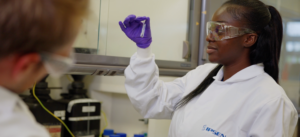
Pollutants from preservatives, pharmaceuticals, cigarette products and even cosmetics end up in our water system – so we need to know what happens next. With the support of my supervisor Dr Konstantinos Gkrintzalis, I’m exploring how the water flea reacts to these pollutants, because whatever impact they have on the water flea has a knock-on effect for the entire ecosystem. These tiny crustaceans can replace more complex organisms in animal testing, as their use is both more ethical and more cost-effective.
My first academic paper was published in Water, examining the impact of parabens on the water flea. Parabens are often found in our food, deodorant and cosmetics, so we wanted to work out what concentration levels would be harmful. Humans share a lot of enzymes with Daphnia, so we can learn a lot about our own reactions from them.
Right now, I’m carrying out a similar study on the impacts of cigarette products in water, and we’re writing a paper exploring the challenges of urban light pollution on aquatic life.
“Research like this underpins environmental regulations, and I’m really proud to be part of that.”
Outside my research, I also work part-time work as a science teacher with the Centre for Talented Youth Ireland in DCU, teaching gifted 8- to 17-year-olds. I get so much from these students, and to hear them talking about going on to do their own PhDs someday gives me so much motivation for my own science career.
Knowledge is power. I see that in my own life, in my research, and in the children I teach. I’d love to continue as an educator, because I recognise the difference a science education can make. The more we teach students, the more easily they will realise when they’re being fed science misinformation online, whether it’s about their health or the climate or any number of things. That’s so important, especially now.”